Direct heat
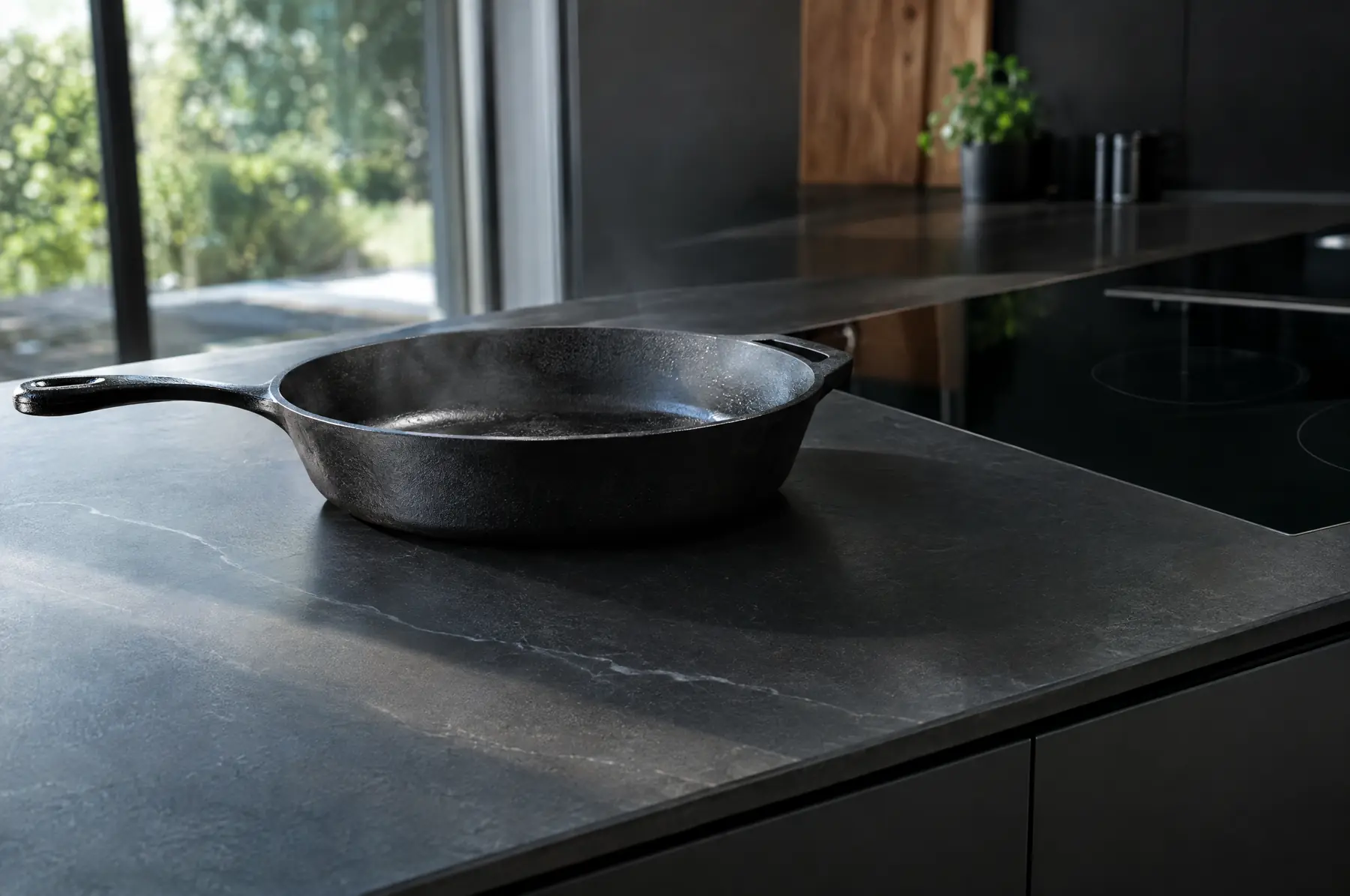
The manufacturer states that it resists high temperatures, so a pan straight off the hob should not mark it.
Dekton is Cosentino's ultra-compact surface: it withstands direct heat, scratches and sun without fading, which makes it one of the best-suited materials for outdoor kitchens and homes by the sea. Its weak point, as with all ultra-compact materials, is the edges when they take a hard knock.
The manufacturer states that it resists high temperatures, so a pan straight off the hob should not mark it.
It resists UV light without yellowing, even on south-facing terraces.
No stains soaking in and no sealing: salt and grease come off with water and soap.
Dekton worktops are one of the best-suited options in Tenerife when the kitchen gets direct sun, is right on the seafront or is built outdoors. Dekton is a Cosentino brand; the generic material is an ultra-compact or sintered surface, from the same family as large-format technical porcelain.
Dekton is a blend of the minerals used to make glass, porcelain and quartz, compacted under very high pressure and fired at very high temperatures. That process, which Cosentino calls sinterised particle technology, produces a resin-free surface with almost zero porosity. Its three main advantages come from there: heat, scratch resistance and stability in the sun.
Dekton resists direct heat, scratches and stains better than quartz. You can put down a hot frying pan without it leaving a mark, although with uneven-bottomed pans or very sudden thermal shocks in one spot it is a good habit to use a trivet to protect the finish. Metal pans can leave grey streaks when dragged across it: they are not scratches but traces of metal that come off with a cream cleaner. Liquids do not soak in, so wine or oil do not leave rings.
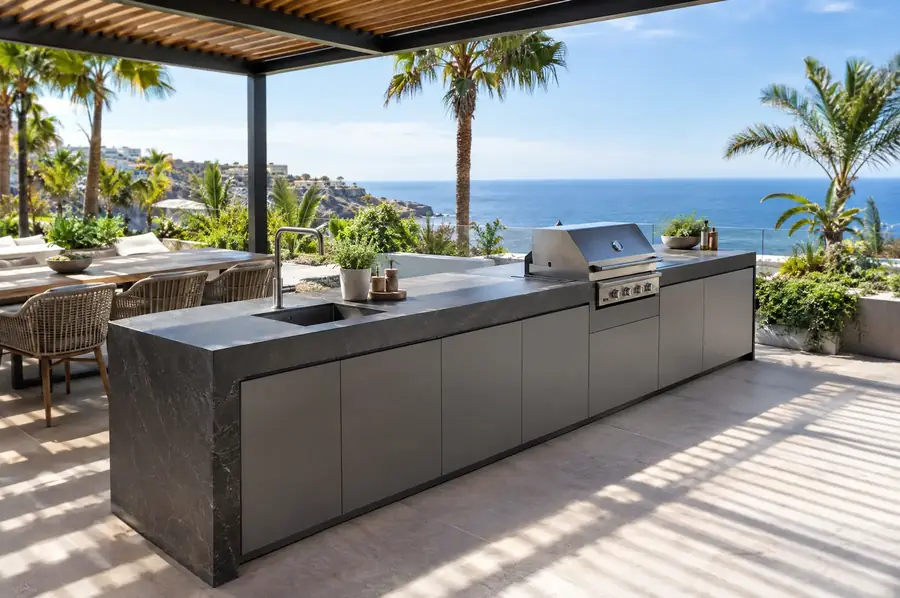
Dekton is suitable for outdoor use because UV light does not alter its colour, and its near-zero porosity stops salt air and moisture getting into the slab. That is why it works for outdoor kitchens, barbecues on terraces in the south and seafront homes. On the coast, salt stays on the surface and a rinse with fresh water is enough. What does suffer by the sea is everything around the worktop: hardware, hinges, taps and fixings should all be stainless steel suitable for a marine environment.
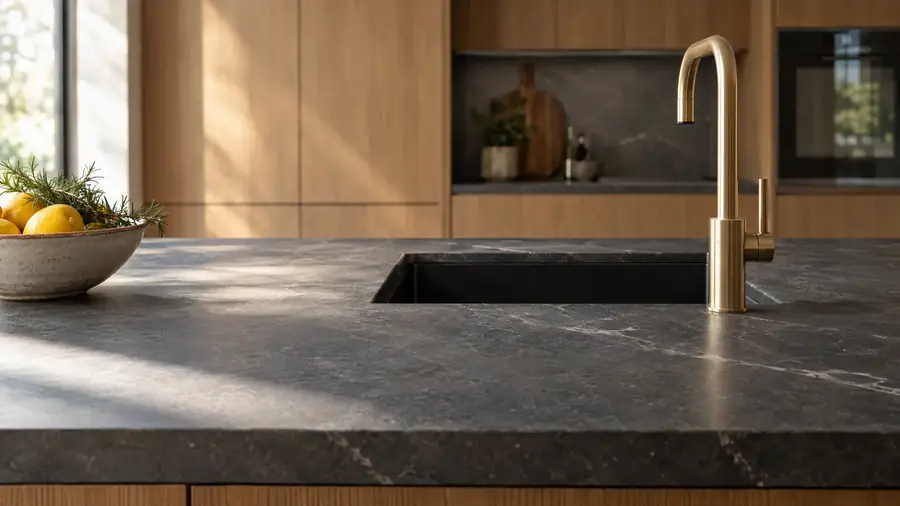
Dekton is made in several thicknesses, from very thin sheets for cladding up to 20 and 30 mm, although not every colour comes in every thickness. For worktops, 12 or 20 mm is the norm. The range includes marble, stone, concrete and oxidised metal effects as well as plain colours, in matt, polished or textured finishes depending on the model; in some models the veining runs through the thickness of the slab and in others it is only on the surface, which affects the choice of edge.
The edge is its weak spot: a sharp knock from a heavy pan can chip it. That is why we recommend an eased edge rather than a sharp corner, or a mitred edge on islands, which also gives the look of extra thickness.
Dekton is cut with specialist machinery and handled carefully during transport and fitting, because large-format slabs are fragile until they are resting on the units. It takes an undermount sink, drainer grooves and a matching splashback. It is normally priced per linear metre, and the price depends on the colour, thickness, edges, cut-outs and splashback.
If you are deciding between Dekton and a porcelain worktop such as Neolith or Laminam, the performance is very similar and the decision usually comes down to design. Compared with Silestone quartz, Dekton wins on heat and sun. Our comparison of Silestone, Dekton, granite and porcelain and the main worktops page will help you make the final choice.
Open the planner with this starting point already chosen. Then change the measurements, units and finishes, and see the drawing and an estimated price including IGIC straight away.
Yes, and it makes sense when there is an indoor kitchen and another on the terrace: Silestone inside, out of the sun, and Dekton outside. Both are made by Cosentino, but their colour ranges are not identical, so look at the samples side by side if you want the shades to match.
Yes, Cosentino also sells it for façades, flooring and exterior cladding, in specific thicknesses and finishes. That means the outdoor kitchen worktop and the cladding on the bar or the wall can be in the same material.
Yes. The surface is harder than knife steel, so it does not scratch, but it does blunt the blade. Always use a chopping board, which also avoids grey metal marks that, although they clean off, are annoying on light colours.
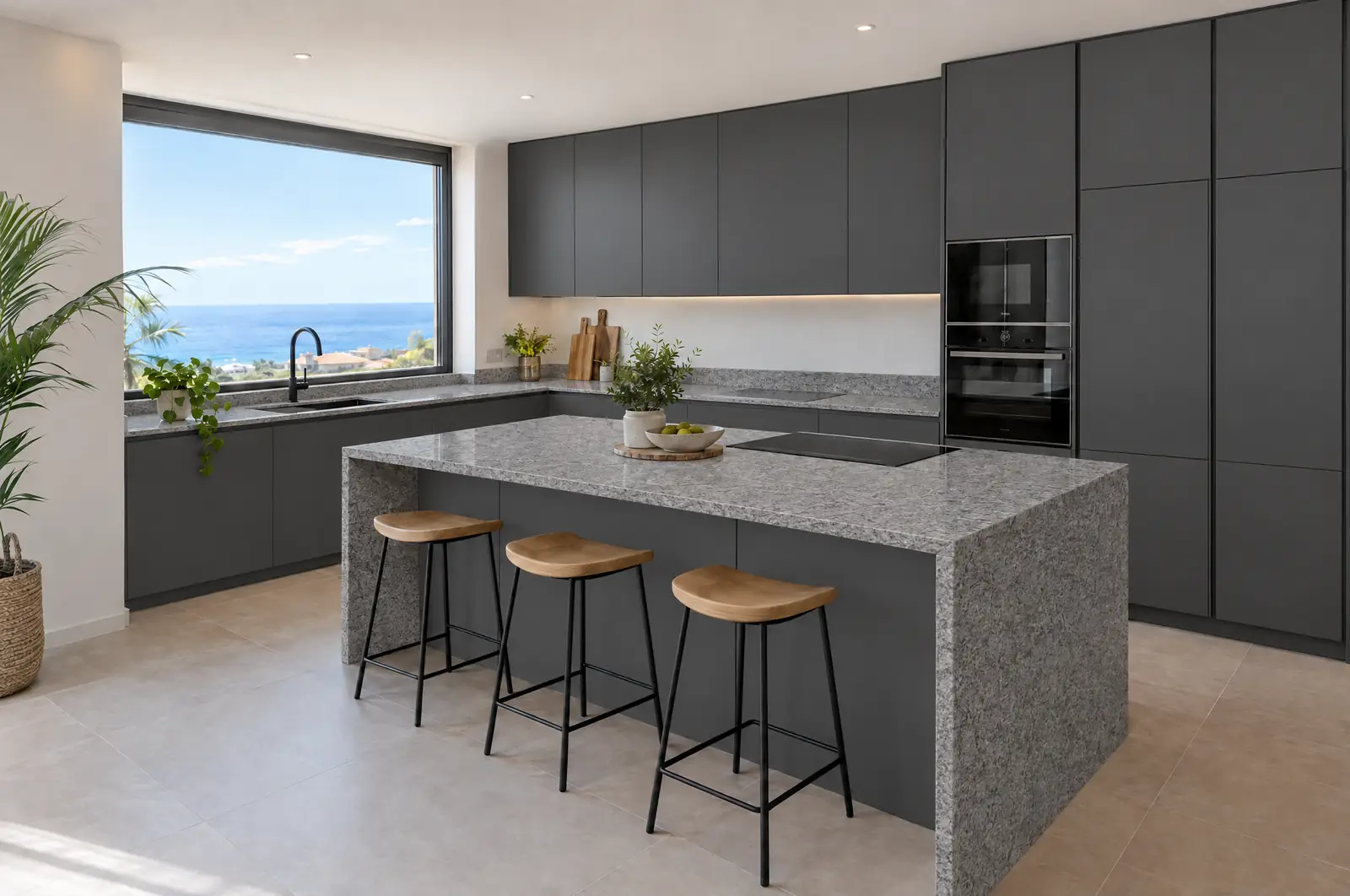
See how it would look and what it would cost in the kitchen planner, or ask us to visit and measure your home.
We will reply with a proposed visit and a first price range. If you prefer to talk, message us on WhatsApp.
Your privacy
We use technical cookies so the website works and, only if you accept them, Google Analytics cookies to understand how it is used and improve it. We do not use advertising cookies. Cookie policy