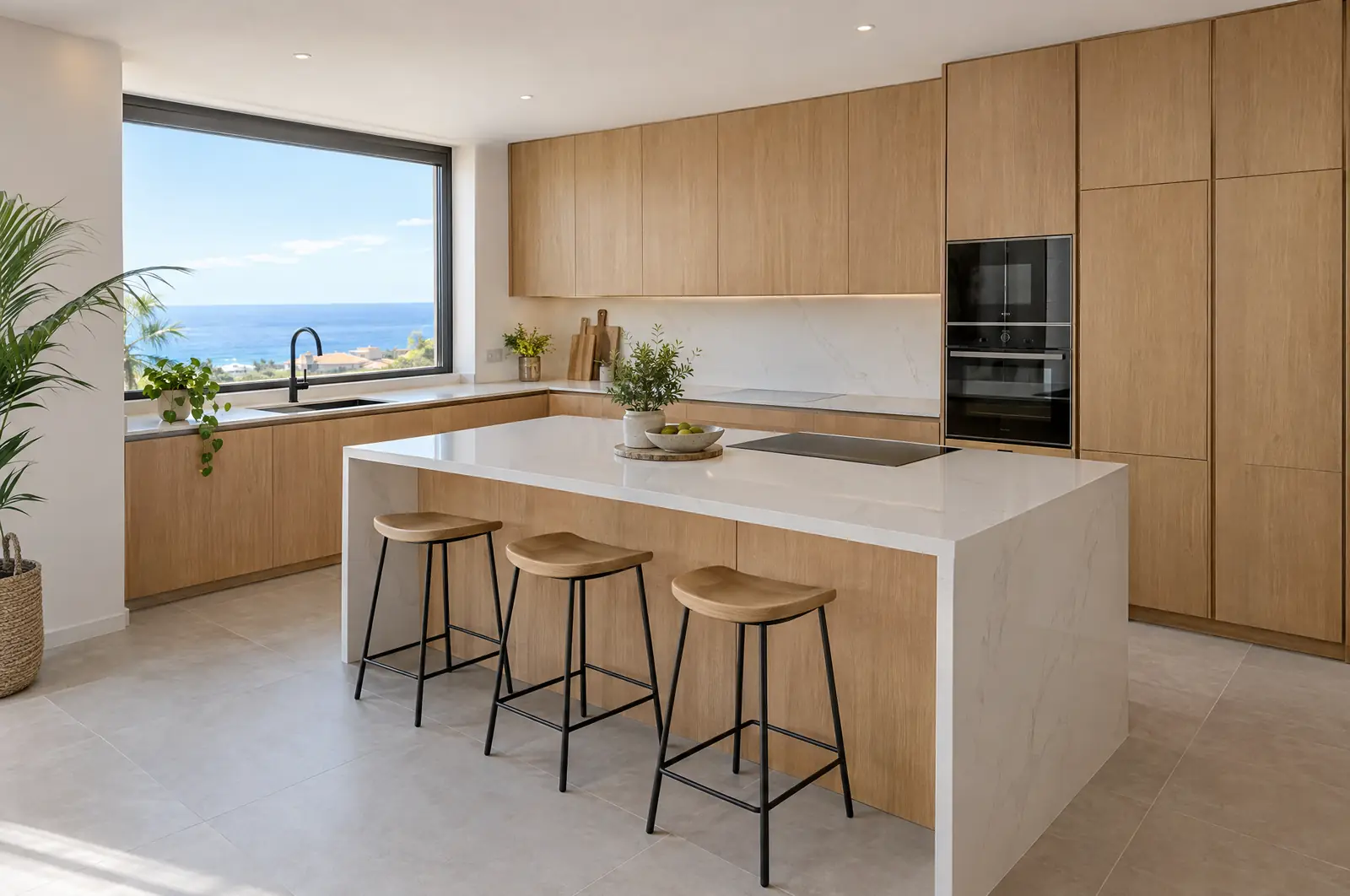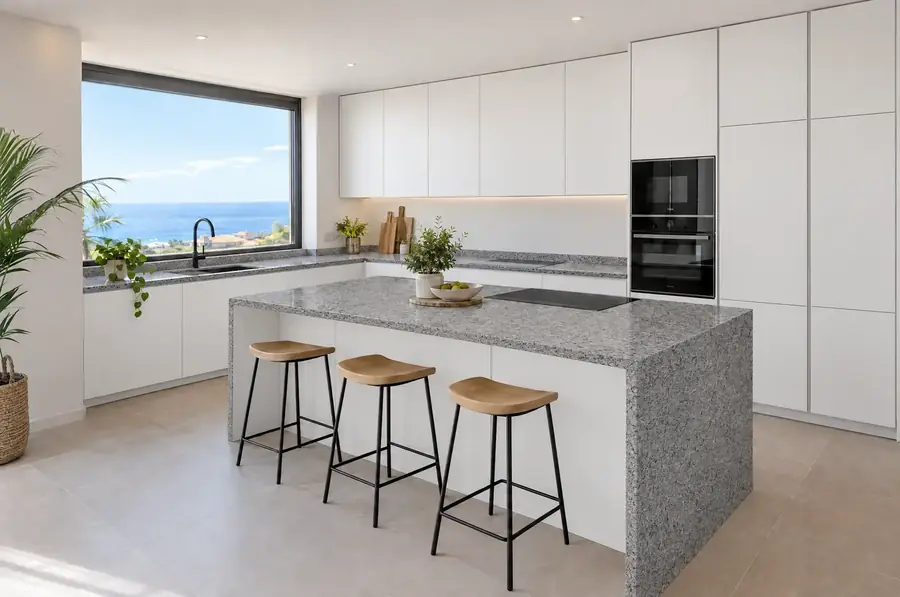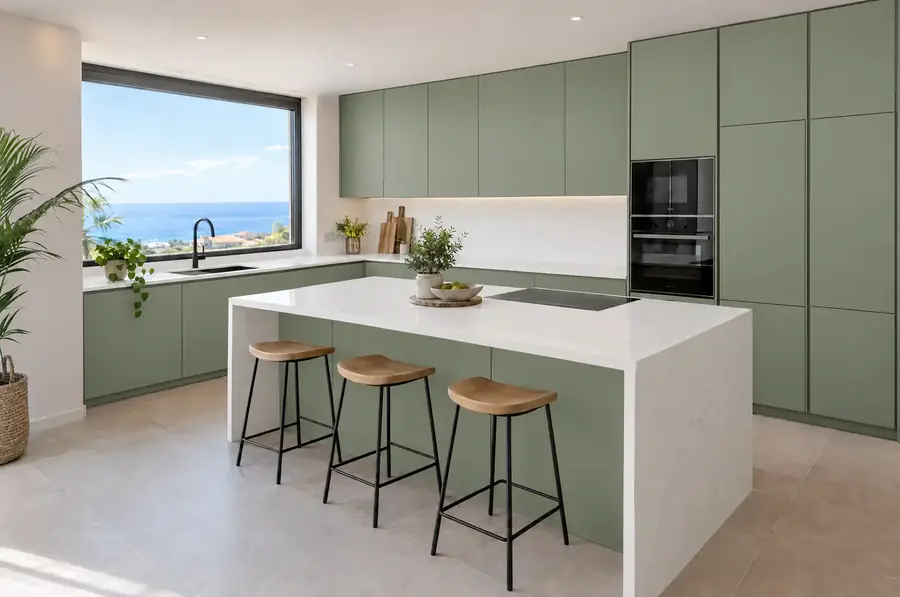
Buying a new kitchen in Tenerife goes well when decisions are made in the right order: first the scope of the work and the budget, then the layout and, last of all, colours and handles. If you choose the worktop colour before knowing where the water supply reaches or how much you can spend, it is easy to end up redoing the project.
First decide whether you are replacing units only or doing building work
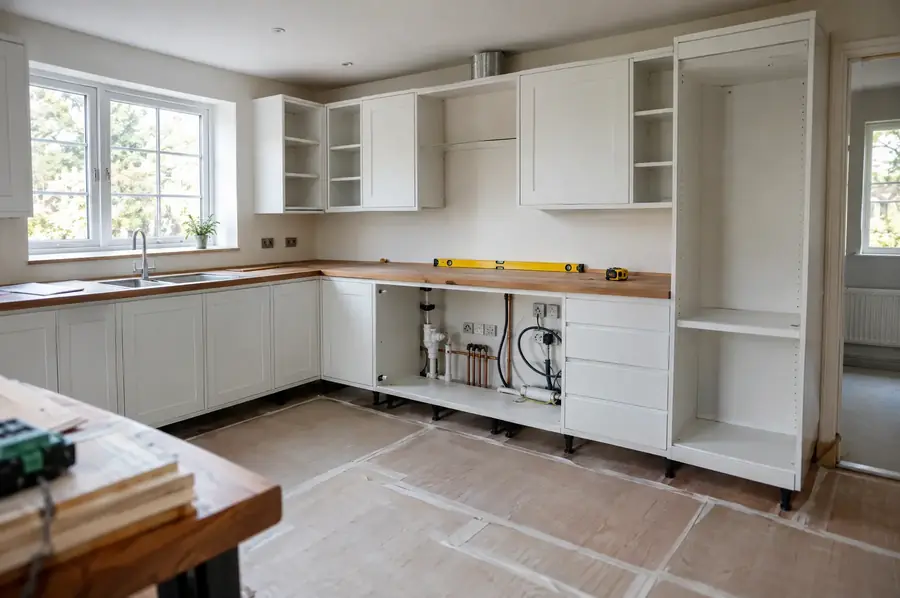
The first decision is whether you keep the current layout or change it, because that determines whether there is building work. If the sink, hob and fridge stay where they are, the job is limited to removing, fitting and connecting. If you move the sink, open the kitchen to the living room or change the floor, plumbing, electrics and building work come into play.
There is a middle ground worth knowing about. You can keep the units and change only the doors, or renew the worktop without touching the rest. These are valid options when the carcasses are in good condition; if the problem is that the kitchen does not work (not enough free worktop, no room for the dishwasher, a narrow walkway), changing the fronts only papers over it.
Set a budget before looking at catalogues
The budget comes before the catalogues, because in a kitchen the difference between ranges is huge and it is easy to fall for something that does not fit. Think of a total figure and split it into three blocks: units and worktop, appliances, and building work.
The split varies a lot from case to case. In a kitchen with no building work, units and worktop take the largest share. In a full renovation, the building work can weigh as much as the units. For a reference based on your measurements, the Tenerife kitchen price calculator gives you an indicative range before you ask for a firm quote.
IGIC in the Canary Islands
In Tenerife you do not pay VAT (IVA) but IGIC, the Canary Islands sales tax. The general rate is 7 %, and it is the one normally applied to kitchen units and their installation. When you compare quotes, check that each one states whether the price includes IGIC or not: a 7 % difference can make an offer look cheaper than it is.
If you compare with prices on websites from mainland Spain, the advertised price is not what you will pay. Those prices include VAT, which does not apply to a delivery to the Canary Islands, and in return the goods pay IGIC on entering the islands, with the customs formalities that involves. On top of that comes sea freight, which adds up with bulky furniture, and the question of who measures, who fits and who is responsible if a part arrives damaged.
Take measurements, but do not place the order with them
Your own measurements are useful for a first sketch and for asking for comparable quotes; the final measure-up should be done by whoever manufactures or installs. Measure the length of each wall, the height to the ceiling and the position of windows, doors, water supply, waste outlet, extraction outlet and sockets.
Also note what does not show on a plan: whether there is a pillar, whether the wall is out of plumb, whether the floor is uneven or whether a low window rules out wall units. In older flats in Santa Cruz and La Laguna it is common to find walls that are not at right angles, and in traditional houses in the north, thick and irregular walls. All of that is solved in the workshop if it is known beforehand.
Choose the layout before the materials
The layout is the decision that most affects daily use, which is why it comes before the finishes. A well-planned L-shaped kitchen with inexpensive doors works better than one with a costly worktop where you cannot open the dishwasher and the oven at the same time.
Think about how you cook: how many people work at once, whether you eat in the kitchen, how much storage you need and which appliances you want integrated. That decides between a single wall, L-shape, U-shape, galley, peninsula or island. The guide to kitchen layouts gives the minimum dimensions for each one.
How to choose a company without getting it wrong
Choose the company by how it measures, designs and fits, not only by the final price. Ask for at least two or three quotes and compare them line by line, because two similar totals can hide carcasses of different thickness, hardware without soft-close or a worktop without polished edges.
These questions quickly set companies apart:
- Who takes the final measurements and who is responsible if something does not fit?
- Does the quote include removal and disposal of the old kitchen, fitting, appliance installation and connections?
- What board is the carcass made of, how thick is it and what kind of edging does it have?
- Do the hinges and runners have soft-close and full extension?
- Who handles plumbing, electrics and building work if they are needed?
If you are not sure what to look for in those answers, the guide on how to spot a quality kitchen explains each element.
Visit the showroom with your plan in hand
A showroom visit is for touching materials and seeing hardware in action, and it pays off twice over if you bring your measurements and a few photos of your current kitchen. With those, drawing can start on the spot instead of talking in general terms.
In the showroom, pay attention to what photos do not show: how a loaded drawer closes, how an edge looks up close, how a matt front feels and how it shows fingerprints. Also bring a sample of the floor, or a photo in good light if you are not changing it, because the colour of the units is decided with the floor in front of you.
What lead times depend on
The total lead time depends on four things: design and decision time, manufacturing, transport and any prior building work. The most variable stage is usually the first, because it depends on how long you take to finalise the design.
In the Canary Islands there is an added factor: a large share of materials, hardware and appliances comes from mainland Spain, and a delay on a ship or with a specific item moves the installation date. That is why it pays to settle the appliances and the worktop early, as they are the pieces that most affect the schedule. If there is a kitchen renovation with building work, fitting the units does not start until the services, tiling and floor are finished.
Check whether you need a permit
Replacing units without touching the services does not usually require any council procedure, but moving service points, changing the floor or running an extraction outlet through the façade may. The procedure depends on each council (ayuntamiento), so check before setting dates. The guide on the kitchen renovation permit in Tenerife covers the most common cases.